
Claud Charles Castleton
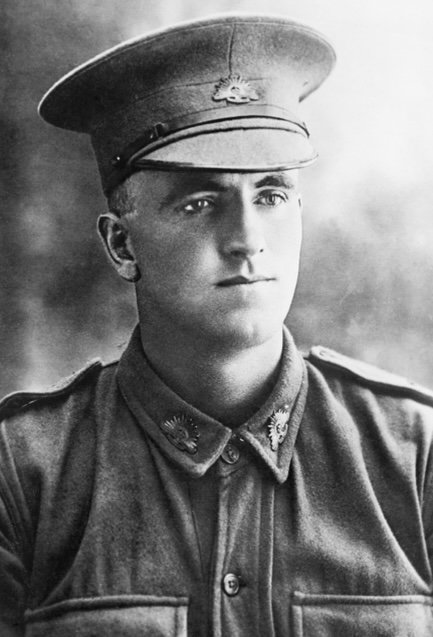
A Sergeant with the 5th Machine Gun Company, Claud died on 29th of July 1916 at the age of 23.
Claud was born at Lowestoft on 12 April 1893, a son of Thomas Charles and Edith Lucy Castleton. In 1901 his family lived at Rose Cottage, Wilson Road, Lowestoft. On 25 October 1897 Claud became a pupil at Morton Road School and from 2 August 1905 attended Lowestoft Municipal Secondary School. Claud also became a pupil at Lowestoft School of Science on 12 September 1905. In September 1910 Claud became a student teacher at Morton Road School. 1911 his family lived at 18 Wilson Road. In August 1911 Claud transferred to became a student teacher at London Road School. On 25 October 1912 he left England, heading for Melbourne, Australia.
Many accounts of Claud’s life state that he was driven by a curiosity for geography and nature. When in Australia he was an itinerant worker and had jobs in Tasmania and Queensland before going to New Guinea to prospect for gold.
On 10 March 1915 Claud attested for the Australian Army at Liverpool, New South Wales, but some sources state that he already had some military service, having been put in charge of local troops in the Port Moresby area and being involved in communication work and coastal defence. When he attested Claud said that he was a prospector.
Claud joined D Company, 18 Battalion. On 25 June 1915 Claud embarked on the ‘Ceramic’ destined for Egypt, where he arrived on 24 July. Claud then went to Gallipoli on 16 August 1915 and his unit was involved in the attack at Hill 60 on 22 August. Around 750 men of the 18th Battalion took part in the attack and an estimated 380 became casualties.
While at Gallipoli Claud contracted dysentery and on 15 September 1915 went to the 1st Australian Casualty Clearing Station for treatment before being evacuated to Hospital Ship ‘Nevaska’. On 19 September he was admitted to No 1 Auxiliary Hospital, Heliopolis, and, on 27 September, admitted to No 4 Auxiliary Hospital at Abbassia. He was transferred to the New Zealand and Australian Convalescence Hospital, at Helanan, before, on 22 October, being discharged to duty.
On 8 November 1915 he embarked on the ‘Royal George’ at Alexandria, heading for Gallipoli, and he joined his unit on 8 December 1915. Claud’s service record shows that he was promoted to Corporal on 7 December 1915.
Claud’s unit was evacuated from Gallipoli and he arrived at Alexandria on 9 January 1916. On 27 January 1916 he was admitted to 8th Field Ambulance, at Ismailia, before being transferred to No 2 Australian Casualty Clearing Station and, on 29 January, the 1st Australian Stationary Hospital. He was found to have malaria. On 16 February he was discharged to duty and the next day he returned to the 18th Battalion. On 20 February he was appointed Temporary Sergeant.
Claud was transferred to the 5th Machine Gun Company, at Moasear, on 8 March 1916. He was promoted to Sergeant on 16 March. On 17 March his unit embarked at Alexandria and, on 23 March, disembarked at Marseilles.
On 20 July Claud’s company moved to Warloy-Baillon, near Pozieres, in readiness for an attack on Pozieres Heights. During the evening of 27 July, a brigade of Australian Infantry, including Claud’s former unit the 18th Battalion, began an assault on the German trenches known as Old German (OG) 1 and 2, located between the Bapaume Road and Munster Alley trench. The attack was met with heavy artillery and machine-gun fire which meant many men were pinned down and unable either to advance or withdraw.
It was in the latter stages of the attack that Claud performed the deeds that would lead to him being posthumously awarded the Victoria Cross. The citation, from the London Gazette 26 September 1916, reads:
For conspicuous bravery. During an attack on the enemy’s trenches the infantry was temporarily driven back by the intense machine-gun fire opened by the enemy. Many wounded were left in ‘No Man's Land’, lying in shell holes. Sergeant Castleton went out and twice in the face of this intense fire and each time brought in a wounded man on his back. He went out a third time and was bringing in another wounded man when he was hit in the back, and killed instantly. He set a splendid example of courage and self-sacrifice.
After his death his personal effects, a bible and three handkerchiefs, were sent to his parents.
Claud’s Victoria Cross, and other medals, are on display at the Australian War Memorial, see Victoria Cross : Sergeant Claud Charles Castleton, 5 Machine Gun Company, AIF | Australian War Memorial (awm.gov.au)
A replica group is on display at the East Suffolk Council Offices committee room Lowestoft.
Claud is commemorated on the Roll of Honour at Normanston Denes High School and the V.C. stone at Lowestoft War Memorial. (With thanks to Julie Durrant)
Tags
Claud Castleton
18
Wilson Road
Lowestoft
United Kingdom
Add new comment